
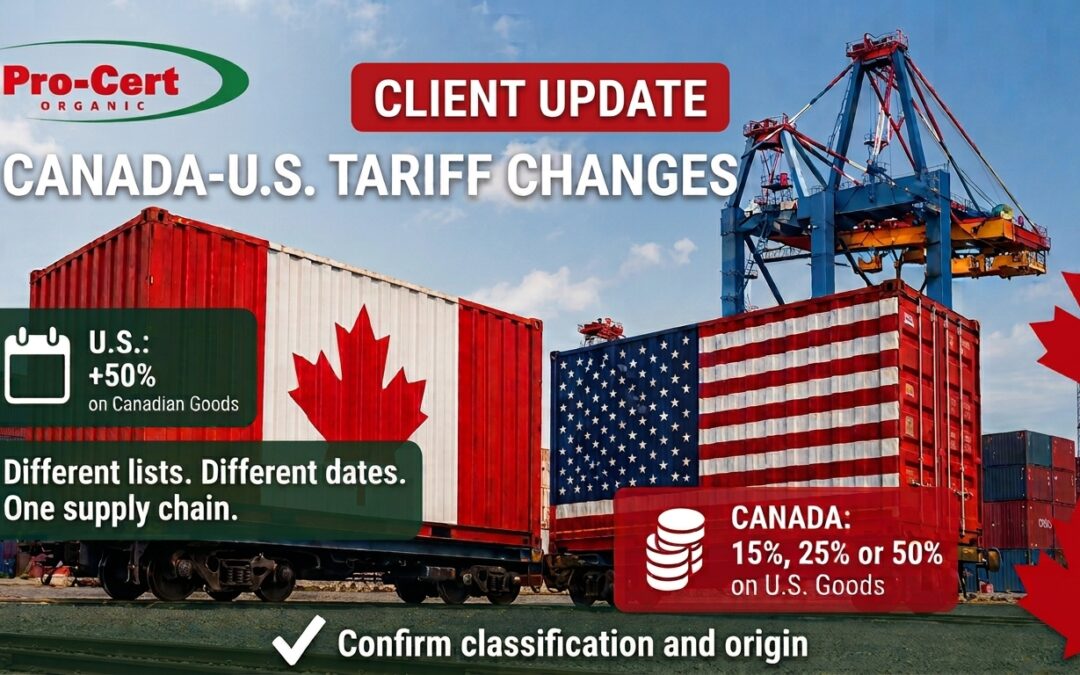
New tariffs are changing the cost and risk of moving certain goods between Canada and the United States. Organic operators should review affected products, suppliers, classifications and documentation before changing their supply chains.
New U.S. tariffs on selected Canadian goods took effect on August 22, 2026. Canada has announced counter-tariffs on selected U.S. goods effective September 8, 2026. Although the two measures differ in their product lists and administration, both can affect organic businesses that import ingredients, finished products, packaging, equipment or other inputs across the border.
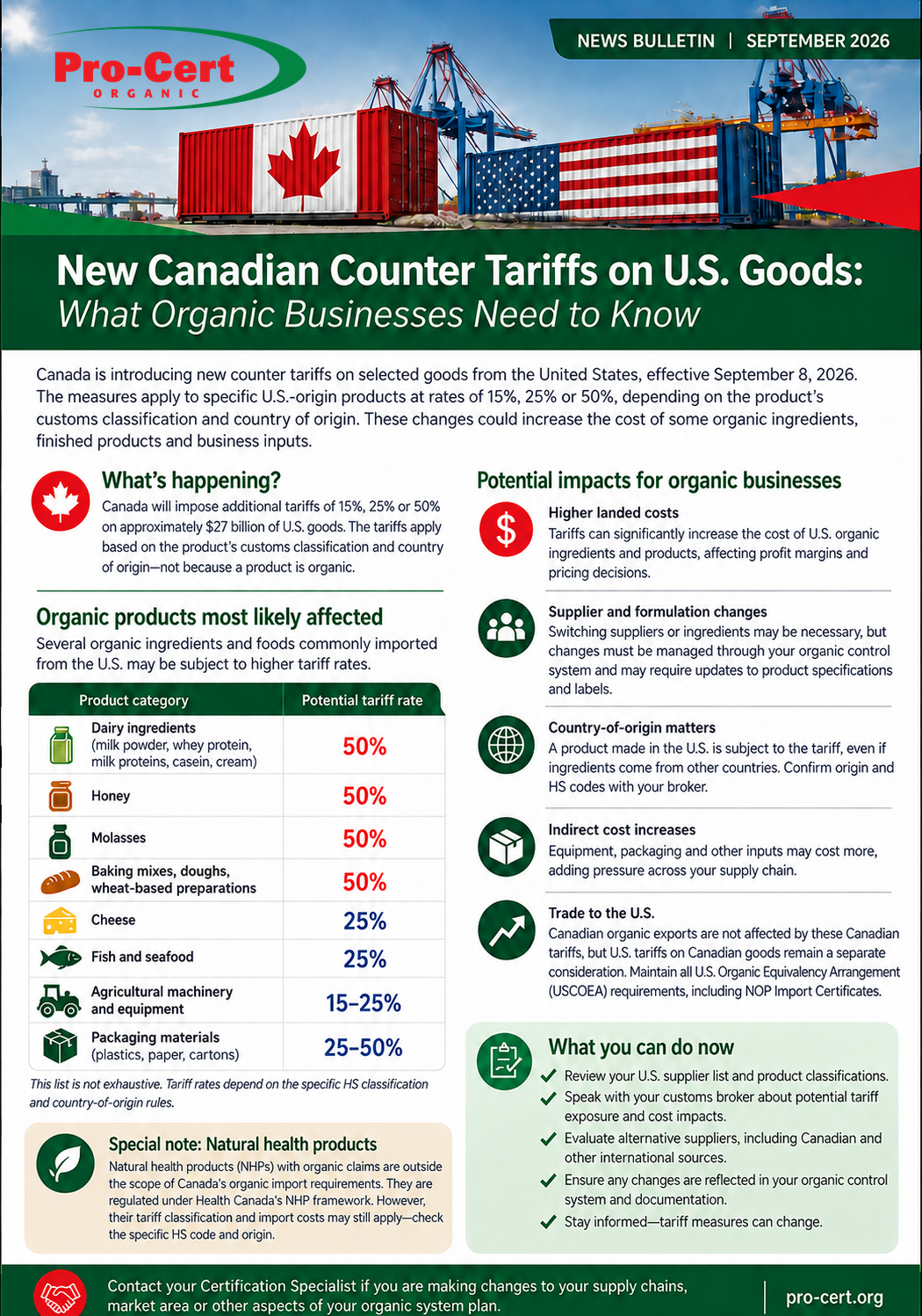
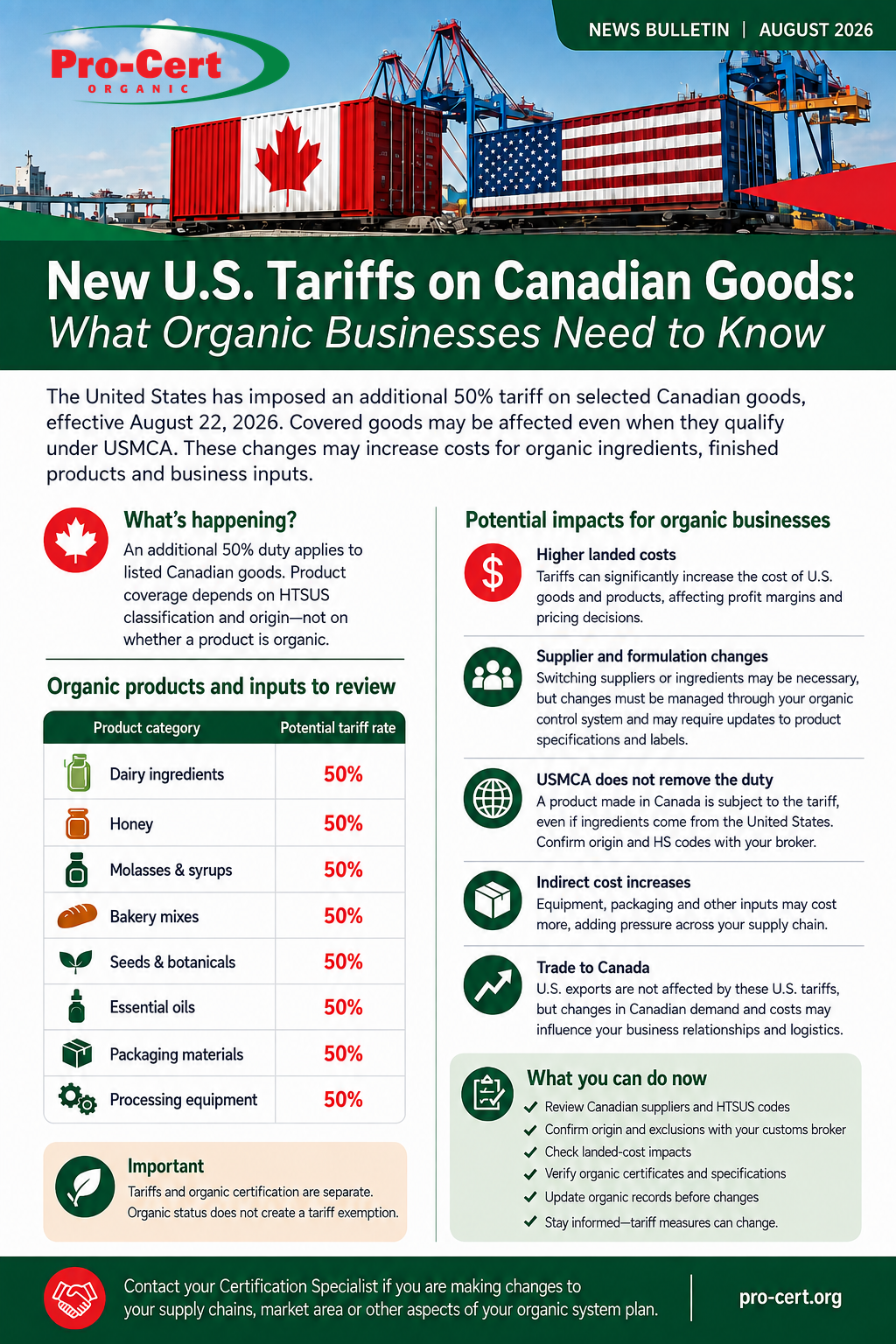
The U.S. measures impose an additional 50% duty on listed Canadian goods. The White House states that these duties apply to covered goods even when they qualify as originating under the United States-Mexico-Canada Agreement (USMCA). Canada’s response applies rates of 15%, 25% or 50% to listed U.S.-origin products, depending on the Canadian tariff item.
Products of potential interest to organic operators
The official lists are based on customs classifications, not on whether a product is organic. Organic status does not create a tariff exemption. Depending on the direction of trade and the exact classification, potentially relevant goods include:
- Milk powders, concentrated milk and cream, whey, milk proteins, casein and related dairy ingredients.
- Cheese and other dairy products.
- Honey, molasses, glucose or fructose syrups, and certain sweetening preparations.
- Certain bakery mixes, doughs and food preparations.
- Seeds, plants, botanical materials, seaweed, natural gums, pectin and related extracts.
- Essential oils, flavouring preparations and other formulation inputs.
- Packaging materials, paper products and plastics.
- Agricultural, refrigeration, packing and food-processing machinery or parts.
This is not a complete tariff list. A plain-language product description is not enough to determine tariff treatment. The controlling factors include the specific HS or HTSUS classification, origin, entry date, applicable exclusions and any overlapping tariff programs.
What all organic operators should review
Map cross-border exposure. Identify ingredients, finished products, packaging, equipment and supplies moving between Canada and the United States. Do not limit the review to products sold under an organic claim.
Confirm classification and origin. Ask the importer of record and customs broker to confirm the tariff classification, country-of-origin determination, effective date and whether exclusions or other duties apply.
Model landed cost. Assess tariffs together with brokerage, freight, currency, inventory timing and supplier pricing. A 50% additional duty can alter the viability of a product or formulation.
Control supplier or formulation changes. Evaluate alternatives before purchase or production. Confirm organic certification status, scope, ingredient composition, processing aids, non-organic ingredient allowances and supporting certificates.
Update the organic system. Where required, update supplier lists, product profiles, formulations, labels, organic control plans and traceability records before implementing the change.
Preserve the audit trail. Retain classification advice, origin evidence, invoices, certificates, specifications, approvals and change records so tariff and organic decisions can be reconstructed.
Specific considerations for Canadian operators
- Canadian exporters should identify products entering the United States under tariff headings covered by the new 50% Section 338 duties. USMCA origin does not, by itself, remove the new duty for covered goods.
- Canadian importers should prepare for Canada’s September 8 counter-tariffs by reviewing U.S.-origin ingredients and business inputs against the official Canadian tariff-item list.
- If a Canadian operator changes from a U.S. supplier to a Canadian or third-country source, it should obtain and review organic certificates, product specifications and any required approval before use.
- Exporters should coordinate with their U.S. customer on which party is the importer of record, who bears the tariff contractually, and whether shipment timing or inventory already in transit affects treatment.
Specific considerations for U.S. operators
- U.S. importers should screen Canadian products and inputs against the applicable HTSUS headings, including dairy and whey ingredients, honey, molasses and syrups, seeds and botanicals, essential oils, packaging, and equipment categories.
- U.S. manufacturers using Canadian inputs should assess whether cost changes could trigger supplier, formulation, package-size or label changes that must be addressed in their organic system plan.
- U.S. exporters should identify goods that Canadian customers may face at 15%, 25% or 50% beginning September 8 and coordinate classification, origin and in-transit documentation with the Canadian importer.
- Operators importing Canadian organic products should continue to verify organic import documentation separately from customs tariff treatment; tariff compliance does not replace organic import requirements.
Tariffs and organic certification remain separate
A tariff does not change whether a product is organic, and organic certification does not exempt a product from a tariff. The connection arises when an operator responds to tariff costs by changing a supplier, ingredient, formulation, process, package or market. Those decisions may require review within the certified organic operation before they are implemented.
| Pro-Cert is here to help. If tariff changes are leading you to consider a different organic ingredient, supplier, formulation or product, contact your Certification Specialist before making a change that could affect certification. Questions about tariff classification, origin, valuation or customs entry should be directed to a customs broker or qualified trade advisor. |
Downloadable graphics:
Recent Comments